
Short answer
X-strap bracing is a pair of flat steel straps fixed diagonally across a light steel wall panel. A thin strap buckles in compression, so it is assumed to work in tension only: one strap is stretched for one load direction, the other when it reverses. End connections, chord studs and anchorage are part of the system too.
Key points
- A strap works in tension only; one diagonal takes over for each load direction.
- The strap force splits into a vertical and a horizontal component: one goes to the chord stud, the other to the track.
- If the strap is on one face only, the eccentricity moment T·e enters the stud calculation (TBDY 2018, 10.4.3a).
- Strap connections are tensioned, and horizontal bridging is placed in panel studs at spacing of at most h/2 (10.4.3b, d).
- The end connection gets a net section check; the joint must not fail before the strap (10.4.2.1c).
In this article
Introduction
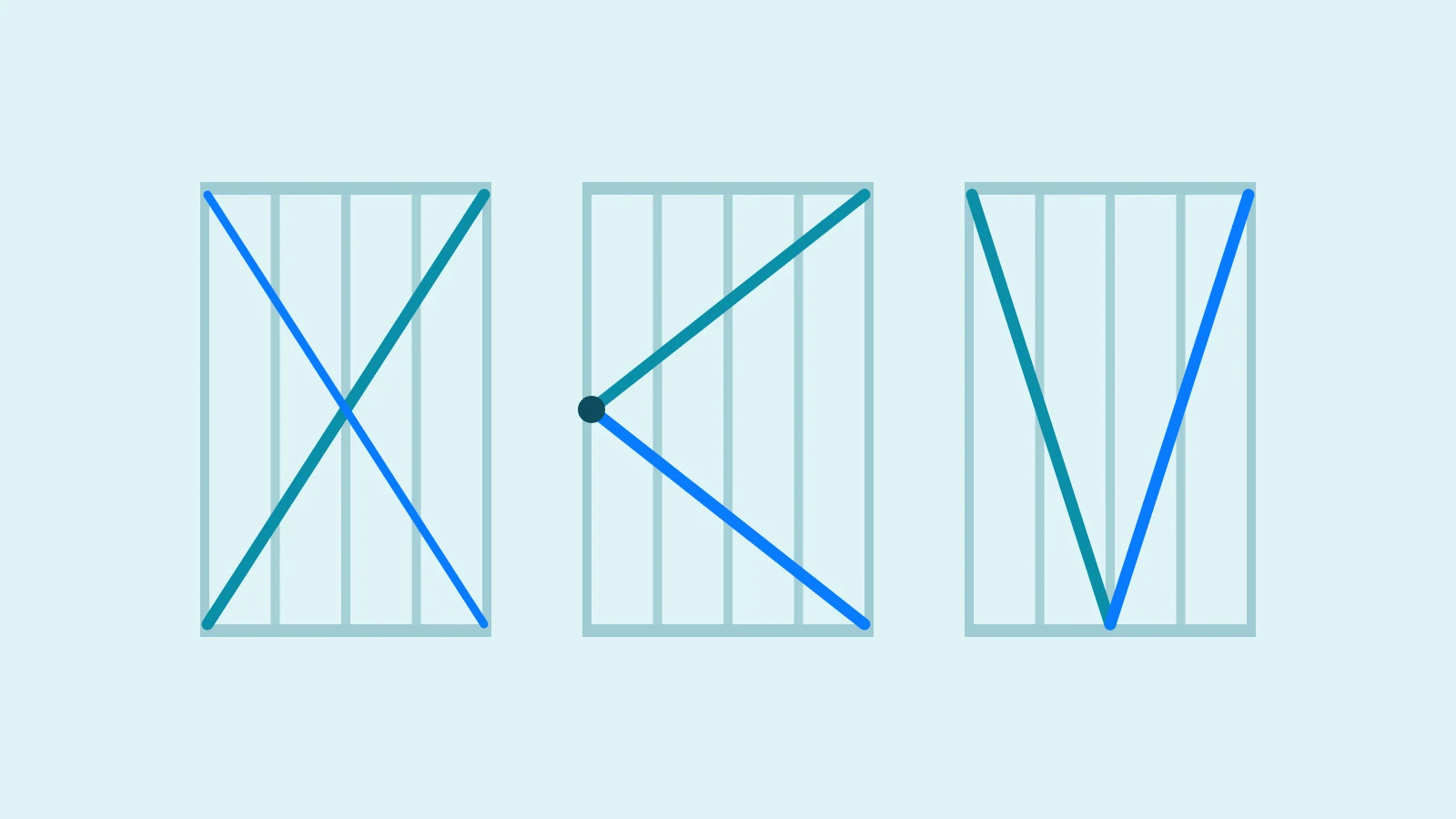
X-strap bracing is a pair of flat steel straps placed corner to corner on the face of a wall panel. Its job is to carry the wind or earthquake force that pushes the panel sideways down the diagonal to the bottom corner. TBDY 2018 covers these systems in 10.4.3, under panels whose braces act in tension only.
Do both straps work at the same time?
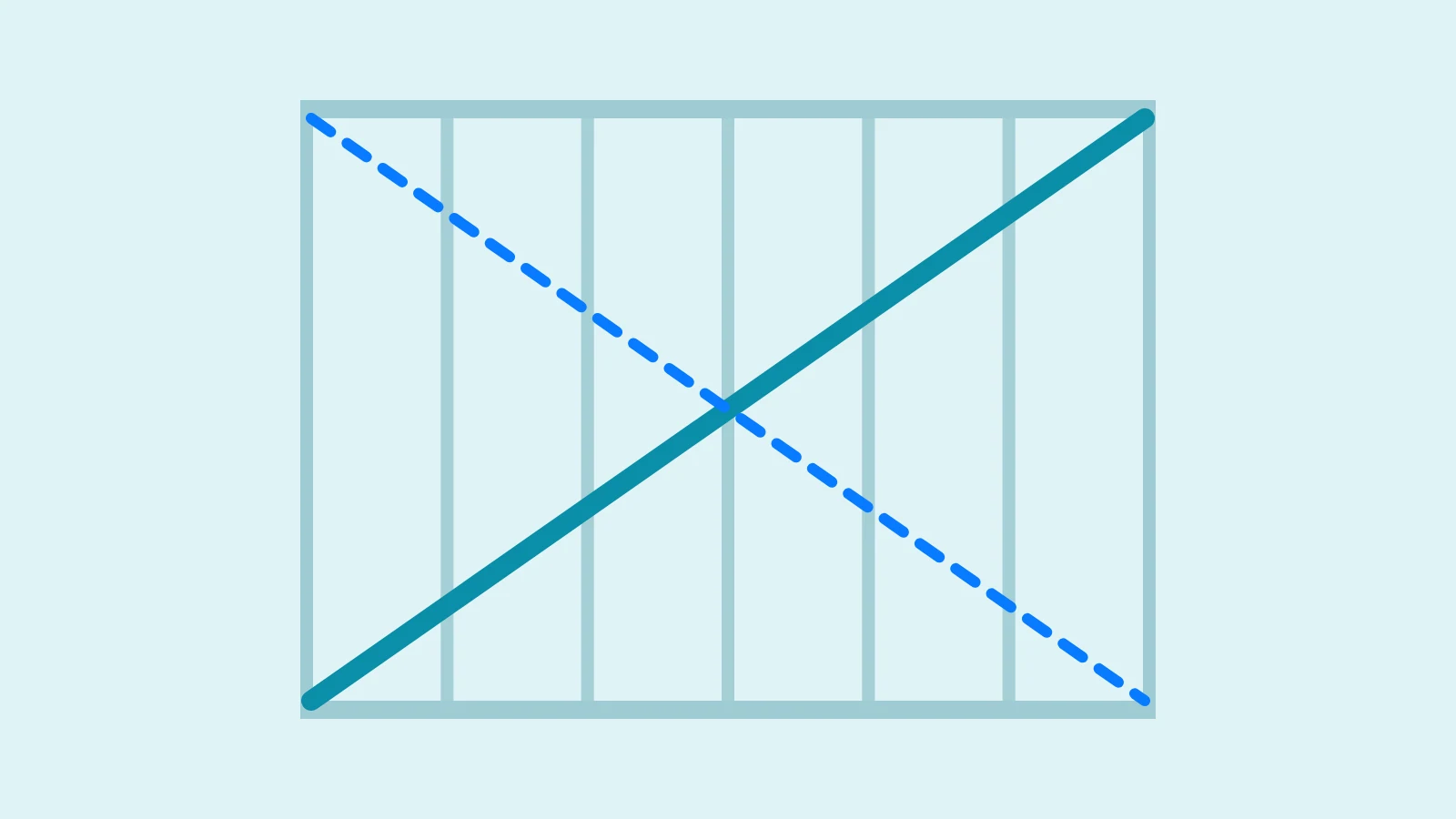
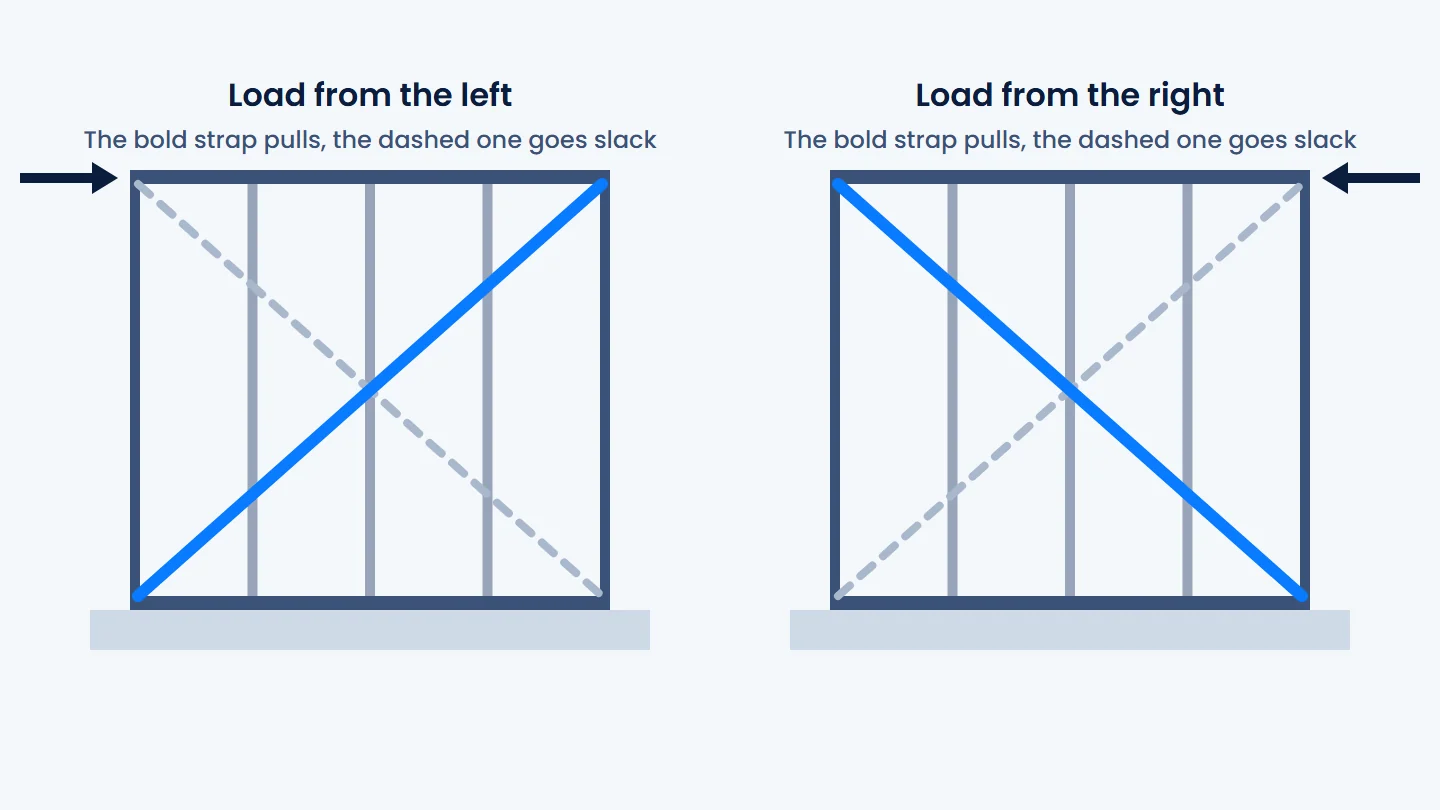
No. When the panel is pushed from the left, the top track moves to the right. The strap joining the bottom left corner to the top right corner tries to lengthen and is stretched. The other strap is forced to shorten; being thin, it goes slack without carrying force. When the load reverses, the roles swap.
This behaviour has two consequences. First, two straps in the drawing do not mean twice the capacity. Second, every load direction is a separate force path: each diagonal has its own end connection, its own chord stud and its own anchorage to follow.
Where does the strap force go?
A stretched strap brings an inclined force to the corner. This force splits into two components:
- The vertical component enters the chord stud. The stud on the tension side sees uplift, the stud on the opposite side sees compression.
- The horizontal component passes to the track and from there to the base anchors.
- The tension in the stud is handed to the structure below by the hold-down at the panel end.
The narrower the panel, the steeper the diagonal and the larger the vertical component. So the same force strains the chord stud and anchor more in a narrow panel. Knowing the general rule does not replace calculation: the ratios come out differently in every panel.
Read nextWhat is the difference between a hold-down and a shear anchor?Should the strap be on one face or both?
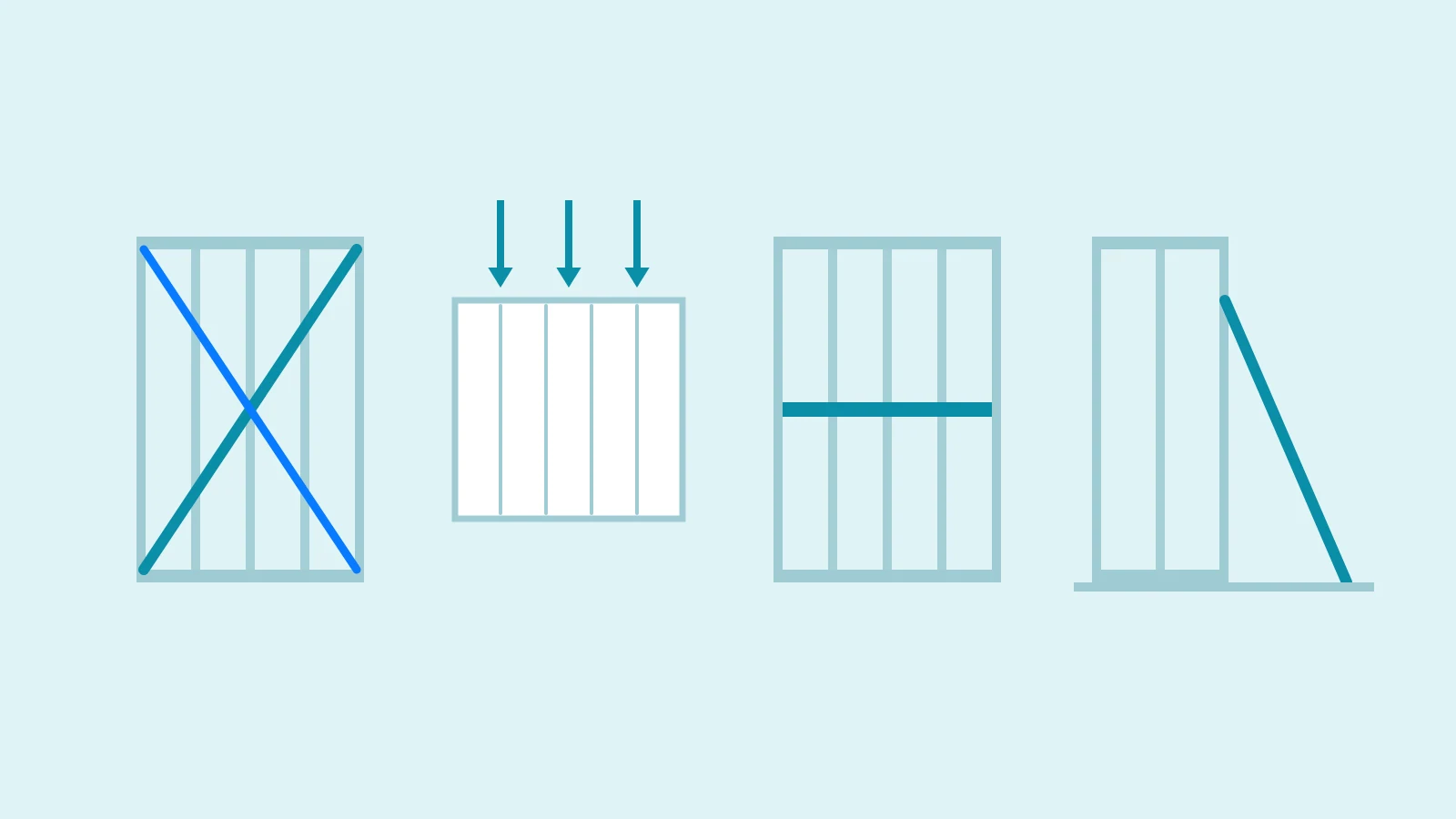
Both are used, but they are not the same. If the strap is on one face of the panel, the force acts away from the stud axis. This offset creates an additional moment in the stud. TBDY 2018 10.4.3(a) says so explicitly: where strap bracing is not applied on both sides of the panel, the T·e moment arising from eccentricity is taken into account in the stud calculations.
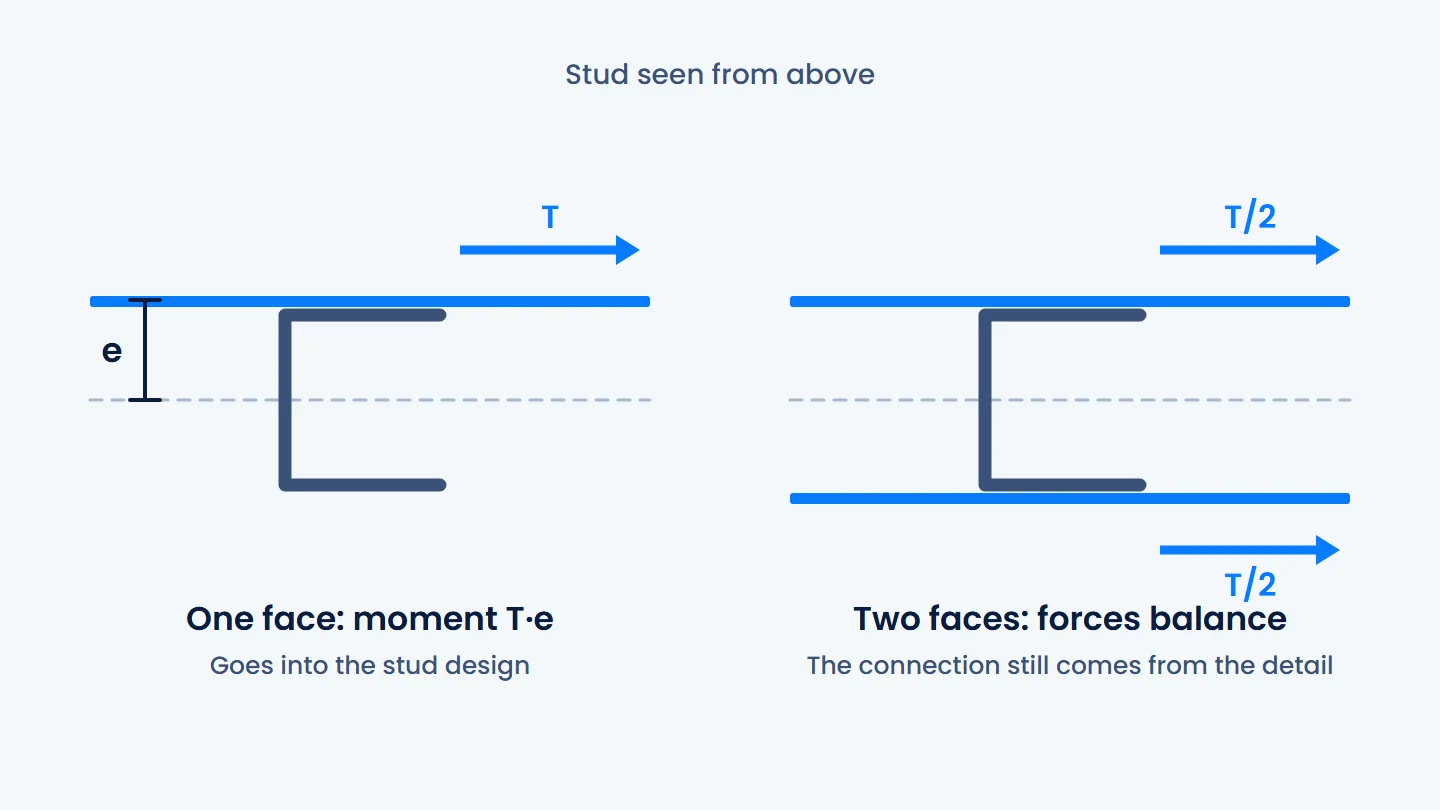
A two-sided layout reduces this moment, but it is not a verified solution by itself. Access to the connection, the sheathing layout and whether the two straps deliver force to the stud at the same point are still read from the detail.
What does the code require of the end connection?
TBDY 2018 10.4.2.1 asks for three things together. The design tensile strength of the brace is found on the gross section. At the point where the brace connects to the chord stud and track, a net section check is made, and the net section strength must be at least 1.20 times the design strength of the brace. The stud, track and connection elements it attaches to carry the forces increased by the overstrength factor D in Table 4.1.
The purpose of these rules is the same: let the weak link of the system be the length of the strap, not the joint. A brace that yields along its length and dissipates energy behaves in a ductile way; a strap that tears at the holes or a screw group that pulls out cuts that behaviour short.
Read nextGusset plates and strap end connections: how does force pass into the frame?Why does strap tension matter?
TBDY 2018 10.4.3(b) requires the connections of strap bracing to be made tight. A slack strap first takes up its slack when load arrives, and the panel moves in the meantime. Because the brace engages late, the wall behaves more flexibly than expected.
Read nextStrap tension and tensioners: why does slack bracing cause problems?Why is bridging needed?
TBDY 2018 10.4.3(d) requires horizontal bridging in the studs of lateral load-resisting panels at spacing of at most h/2, where h is the panel height. Bridging is not part of the strap. It shortens the buckling length of the stud. When the extra compression from the brace is loading the chord stud, this shortening matters even more.
What mistakes are most common with X-strap bracing?
- Assuming both straps work at once and splitting the force in two.
- Checking the strap and forgetting the chord stud and anchorage.
- Leaving the eccentricity of a one-sided strap out of the stud calculation.
- Cutting the strap for services or shifting it elsewhere.
- Assuming the X crossing is a real connection without looking at the detail.
- Copying the strap width or screw count of another building as an example.
How does an X layout look in QSteelCAD?
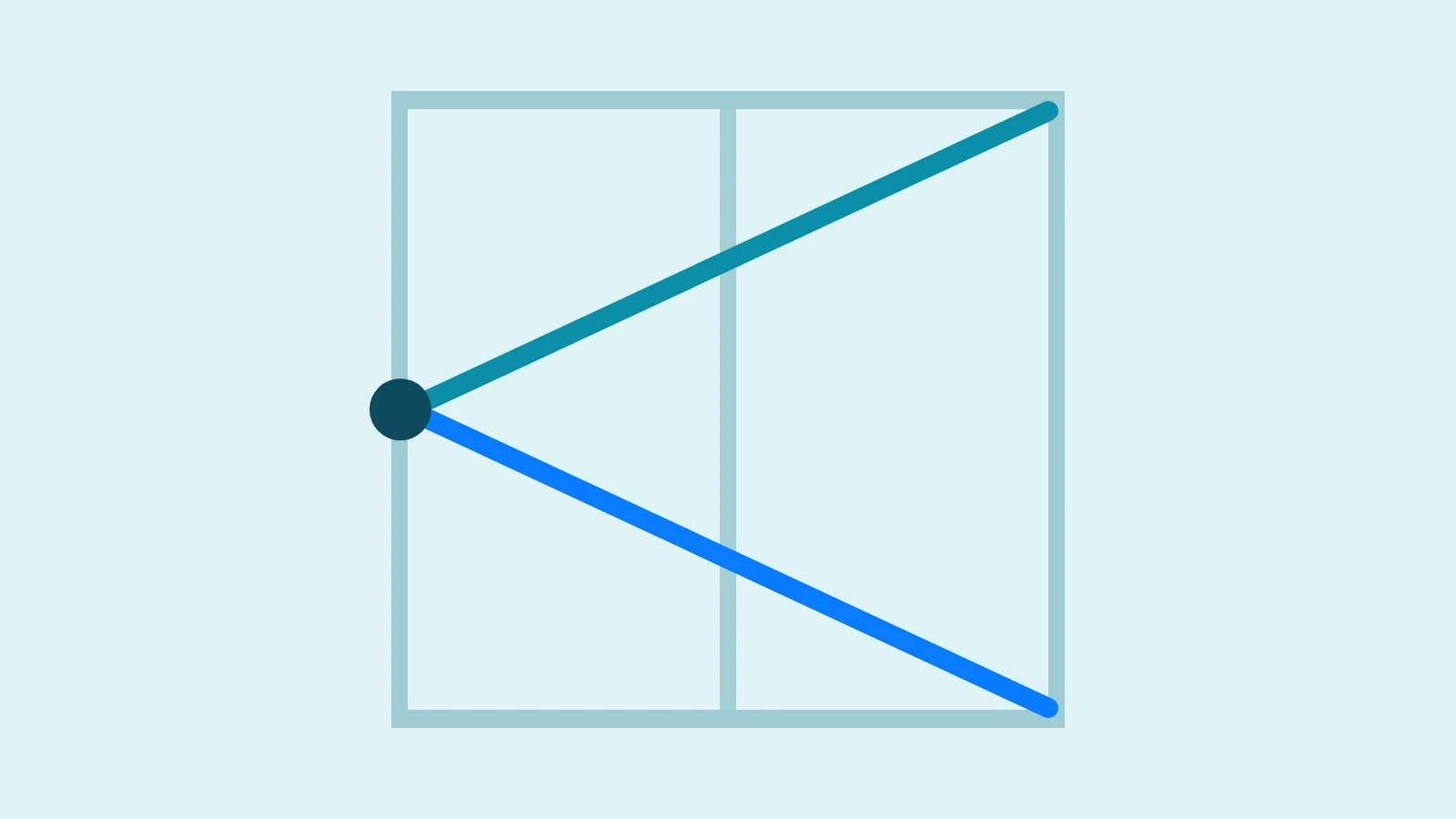
In QSteelCAD the Bracing command builds a profile brace in the bay you click. A second click in the same bay flips the braces, and a third click returns them to the first state. The cut lengths and flange directions of flipped braces are the exact mirror image. If the bay is not suitable, no brace is built and the program states the reason.
Frequently asked
Does X-strap bracing carry compression?
No, a thin strap is assumed not to carry compression. When the load reverses, the opposite diagonal goes into tension and carries the force.
Should the straps be connected where they cross?
That depends on the detail of the system. Whether there is a connection at the crossing is read from the project detail; straps appearing to cross in a drawing does not show a shared node.
Can the strap be used on one face only?
It can. TBDY 2018 10.4.3(a) then requires the T·e moment from eccentricity to be included in the stud calculation.
How is the strap width chosen?
It is calculated from the panel force, steel grade, thickness and the net section check. It is not taken from a photograph or another project.
This article is general information. It does not replace project calculations, an engineer's approval or the official text. Articles and values were read from the texts in force on the article's date.